
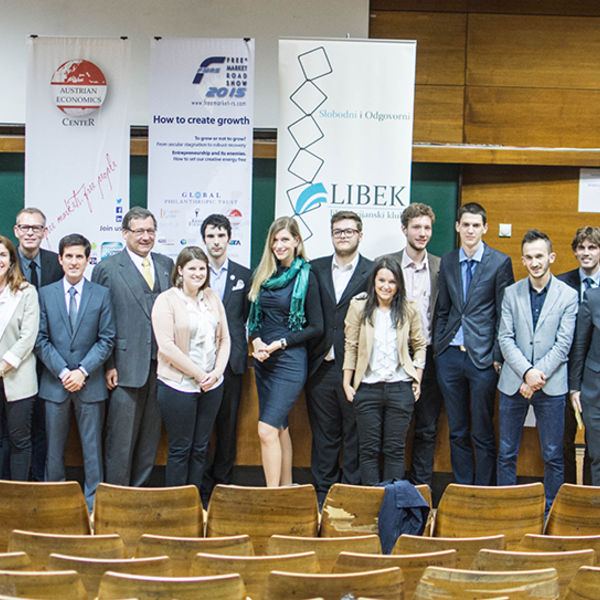
Conference „Free Market Road Show”, organized by Libek and Austrian Economic Center, was held yesterday, April 29th at the Faculty of Political Science in Belgrade. This year FMRS visits 35 cities all over Europe, and is in Belgrade for the eighth time in a row. „Free Market Road Show” gathers businessmen, students, experts and politicians, as well everyone with interest in economic and personal liberties in order to discuss ways in which economic freedom, rule of law and protection of private property lead to economic growth.
This years conference encompassed two topics that are hot in Europe and Serbia. First panel, moderated by Mihailo Gajić, director of Research Unit of Libek, was titled „To grow or not to grow? From secular stagnation to robust recovery”. Richard Zundritsch, independent financial adviser and Board Member at Hayek Institute, spoke of problems with which welfare states in Europe face in the long term. “Problems are solved in the easy, short term way: by monetary expansion. Long term problems of pension systems are kept under the radar”, stated Zundritsch.
Kate Sheehan, Research Associate at the Free Market Institute, rhetorically asked the audience what is that makes some countries rich, and what makes other poor? Kate explained the significance of economic institutions of protection of private property and free entrepreneurship in developed and successful countries: „Sound monetary policy, a good judicial system and market distribution – those are the prerequisits for a healthy and succesful economy”.
Boris Begović, professor at the Faculty of Law at the University of Belgrade, stressed that economic ideas are formed in developed countries and that it is understandable that large, developed economies deal with demand. On the other hand, the problem arises due to disregarding the supply part and that small, undeveloped economies like Serbia copy the same approach to economic policy. Asked how to attain growth, Begović responded: „Do nothing. Let the economy go it’s path”. Begović also spoke about prominent debates concerning inequality and stated that the problem lies in inequality of procedures, not in the
inequality of outcomes.
Pieter Cleppe, from Open Europe, spoke of problematic policies that are present in the European Union, with a special emphasis on centralization of regulation and closed borders. „Instead of European Union being the one creating and promoting trust between citizens of it’s own and other countries, the EU is doing exactly the opposite”. Cleppe also said that European Union should exclude Serbia from demands concerning implementation of expensive and counterproductive regulations.
After the first panel dealt with factors of economic growth and the way to attain it, the second panel „Entrepreneurship and its enemies: How to set our creative energy free?” addressed those that create growth. Second panel was moderated by Nikola Todorić, Local Coordinator for the ESFL. Opening speaker was Vladimir Marinković, vicepresident of the National Assembly of Republic of Serbia and chairman of the Economic Caucus. Marinković spoke of the neccessity to change the bad image that entrepreneurs have at the moment and the need to present them as heroes of society, as they are the greatest hope for economic growth. “We have to make that key step in transfering from a society of clerks to the society of entrepreneurs”, Marinković said.
By comparing Texas and France, Kerry Halferty-Hardy from Alcuin Advisors showed the way in which a country with a free market works in comparison with a country that suffers from a high level of state interventionism. Speaking of negative stance towards entrepreneurship in France, Halferty-Hardy stressed that „Taking risk in France is seen as something that is not acceptable, and is being trampled by over-regulation and bureaucratic procedures”. A proper aproach for Halferty-Hardy would be to provide encouragement to those who fail in order for people to be motivated to try different things and different approaches to their businesses.
Alfredo Pascual, Local Coordinator for the ESFL in Germany, spoke of new markets that emerged after legalization of cannabis in some states in the US. By looking back at the dreadful consequences of the War on Drugs, imprisoning people for non-violent crimes and ecological impact of the ban on cannabis cultivation, Pascual stressed that since marijuana was legalized in Colorado more than 10 000 new jobs were created.
„Free Market Road Show” was closed with a keynote speech given by Matt Kibbe, president and CEO of FreedomWorks, organization that has a grassroots community of close to 7 milion people. Kibbe spoke of unanticipated vast areas of liberty that internet opened up for people, as well as a cheap access to education. He said that states have always collected and witheld information for themselves in order to rule over people, but that internet has provided people with easy access to informations and places in which that knowledge can be shared and used to control the authorities. „Social media is the first thing after what
modern tyrants go when people start to figure things out”, concluded Kibbe